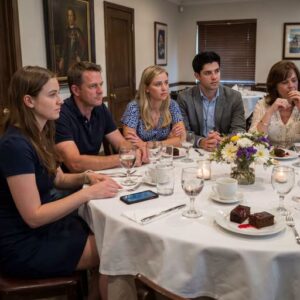
My daughter-in-law slept with my husband one week before we were supposed to sign the divorce papers, and I let both of them believe I knew nothing. At the lawyer’s office, Damon sat beside me with the solemn face of a grieving husband. Ember sat across the table in a cream silk blouse, one hand resting on my son’s sleeve, playing the devoted daughter-in-law so well that a stranger might have pitied her.
Then the attorney slid a document toward me that stripped away my rights, my home, and nearly everything I had helped build in forty-two years of marriage. I read it slowly. Damon would get the house.
Damon would get the business. Damon would get the vacation property, the larger investment accounts, and the right to “maintain continuity” over what the lawyer called family assets. I would get a downtown condo, half the joint savings, and a monthly check small enough to feel like an insult wrapped in legal language.
Ember watched me over the rim of her coffee cup. She was waiting for me to cry. I smiled instead.
Then I picked up the pen. And that was the moment both of them lost everything. Before that day, I was the kind of woman people underestimated because I kept a pretty table.
My name is Naen Morrison. I was sixty-four years old then, living in a brick colonial house at the end of a quiet cul-de-sac outside Raleigh, North Carolina. The kind of neighborhood where people walked dogs before breakfast, waved from driveways, and pretended not to notice when a marriage began falling apart behind plantation shutters.
For forty-two years, I had been Damon Morrison’s wife. I had raised our son, Wade, in that house. I had hosted Easter lunches, birthday dinners, Christmas Eve cocoa, Fourth of July cookouts, and the kind of Thanksgiving meals where everyone loosened a belt and still found room for pie.
I polished silver before holidays. I kept hydrangeas alive through brutal summers. I remembered who liked dark meat and who couldn’t eat pecans.
I believed in small gestures. Fresh towels in the guest bathroom. A real card in the mail instead of a text.
Good china for family even when family no longer deserved good china. That was my mistake, perhaps. Not kindness itself.
Kindness is never the mistake. The mistake is assuming people who benefit from your gentleness understand its cost. Damon had been distant for months.
Not in the loud, obvious way. Damon was not a door-slammer. He had built a career on polished exits, smooth explanations, and letting others feel unreasonable for noticing what he had changed.
He came home late and said meetings ran long. He wore a cologne I had not bought him. He kept his phone face down beside his dinner plate.
He had begun to speak to me in a careful, patient tone, the way men speak when they have already decided you are part of the old life they are preparing to leave. At first, I told myself what women of my generation were trained to tell ourselves. He is tired.
Work is stressful. Marriage has seasons. Forty-two years is a long time.
But a woman who has shared a house with a man for four decades knows the difference between tiredness and secrecy. She knows when silence changes temperature. She knows when a husband comes home carrying a second life on his shoulders, even if he hangs his coat in the same hall closet and asks what is for dinner.
Then came Sage. She arrived on a Thursday afternoon, pale as paper, with her purse held in both hands like it was the only thing keeping her upright. Sage was Ember’s older sister.
I had always liked her, though I would not have called us close. She was quieter than Ember, less polished, less interested in charming a room. Where Ember entered a gathering like she expected to be admired, Sage entered like she had first checked for exits.
When I opened the door, she tried to smile and failed. “Naen,” she said, “I’m sorry to come by without calling.”
“Don’t be silly. Come in.”
I had just set the dining room table for tea.
Real tea, not because anyone my age needs cucumber sandwiches at three o’clock on a weekday, but because habits become scaffolding when a house feels lonely. There was lemon cake on a pedestal plate, linen napkins folded beside the cups, and afternoon sun falling through lace curtains in pale strips across the floor. Sage sat down, but she did not touch anything.
Her eyes kept moving around the room: the family photographs on the sideboard, the silver-framed picture of Wade at eight years old missing both front teeth, the portrait of Damon and me from our thirty-fifth anniversary, smiling beneath a rented tent in our backyard. At last, I said, “Sage, what’s wrong?”
She looked at me, and I knew before she spoke that whatever she had brought into my house would not leave easily. “I need to tell you something,” she said.
“And I don’t know how to do it without hurting you.”
I folded my hands in my lap. “Then tell me plainly.”
Her mouth trembled. “It’s about Damon and Ember.”
The room went very still.
Not silent. I could hear the grandfather clock in the foyer. I could hear a lawn mower two houses down.
I could hear a dog barking somewhere beyond the fence. But inside me, everything stopped. “What about them?” I asked.
Sage swallowed. “They’re having an affair.”
There are sentences that do not enter the body all at once. They arrive like weather.
First the chill. Then the pressure. Then the realization that something has shifted overhead and you are standing in the path of it.
I stared at her. She began to cry. “I saw them downtown.
At that little café near Damon’s office. They were in the back booth. He had his hand on hers.
She kissed him, Naen. It wasn’t accidental. It wasn’t friendly.
It was…” She pressed her fingers to her mouth. “I confronted her later. She didn’t deny it.”
My hand moved under the tablecloth and gripped the edge of the table.
“What did she say?”
Sage looked ashamed, though she had done nothing wrong. “She laughed. She told me I was dramatic.
Then she said you were old and boring, and Damon deserved to feel alive again.”
My throat tightened. “She said that?”
“Yes.”
I looked toward the anniversary photo on the sideboard. Damon’s arm was around my waist in that picture.
His smile looked genuine. Maybe it had been. Maybe that was the cruelest part of long betrayal: it does not necessarily erase what was real.
It only teaches you that real things can rot while still appearing solid from the road. Sage leaned forward. “There’s more.”
Of course there was.
There is always more when a person finally opens the door to a hidden truth. “She said once the divorce was final, she would help Damon make sure you got as little as possible. She said Wade was too soft to notice what was happening, and by the time he did, she’d already be gone.”
The divorce.
Damon had mentioned it three nights earlier, not directly, but in that cowardly way people do when they want to plant a thought and later pretend it grew on its own. “Maybe we should talk about what comes next,” he had said. I thought he meant aging.
Retirement. Downsizing one day. I did not know he meant replacing me with the woman who sat at my Thanksgiving table and called me “Mom” when she wanted something.
Sage took a breath. “She married Wade to get close to the family. I know that sounds awful, but I believe it.
She’s been asking about trusts, deeds, properties, inheritance. She pretends she’s just curious, but she keeps notes. She always has.”
My first instinct was grief.
It came sharp and deep, rising so suddenly that I had to turn my face toward the window. Outside, the rose bushes were blooming along the fence. Damon and I had planted the first of them when Wade was still in elementary school.
Back then, we had spent a whole Saturday digging in the clay-heavy soil. Damon had ruined a pair of loafers and laughed about it. I had believed that kind of memory meant something permanent.
Behind me, Sage whispered, “What are you going to do?”
I kept looking at the roses. The answer formed slowly, not from rage, but from a part of me I had neglected for years. A practical part.
A quiet, watchful part. The woman I had been before marriage taught me to soften my own edges for the comfort of others. “Nothing,” I said.
Sage blinked. “Nothing?”
I turned back to her. “I am going to behave exactly as they expect me to behave.
I will smile. I will host dinner. I will let them think I am tired, sentimental, and harmless.”
“But Naen—”
I poured tea into my cup with a steady hand.
“People reveal more when they believe they are winning.”
That sentence changed the look on Sage’s face. She had come expecting me to crumble. Perhaps she thought she would need to hold me while I wept.
Instead, she watched me take a sip of tea and ask questions. When did she see them? Who else might know?
Had Ember mentioned legal plans? Had Wade heard anything unusual? Did Ember have access to financial documents?
Sage answered everything she could. By the time she left, the lemon cake remained untouched, the tea had gone cold, and the woman I had been that morning no longer existed. That night, Damon came home at 7:43.
I know because I was standing at the stove and looked at the clock above the pantry as his key turned in the lock. I was making pot roast. His favorite Thursday dinner.
Beef, carrots, potatoes, onions, enough thyme to fill the kitchen with the smell of old comfort. He came in, kissed my cheek too quickly, and loosened his tie. “Smells good,” he said.
“Long day?”
“The usual.”
The usual. I almost laughed. He had no idea how loud a lie can sound once a woman stops wanting to believe it.
We ate at the kitchen table because he said he was tired. He checked his phone twice. The second time, his mouth softened in a way I had not seen directed at me in years.
“Everything all right?” I asked. He set the phone face down. “Just work.”
I nodded and passed him the potatoes.
That became my performance over the next two weeks. I made coffee. I asked about his day.
I folded his shirts. I let him believe his late nights were convincing. And when Ember came for Sunday dinner wearing a pale green wrap dress and the same perfume I had smelled on Damon’s collar, I hugged her as warmly as ever.
“Naen,” she said, stepping into my kitchen with a bottle of expensive white wine, “you look beautiful.”
“Thank you, dear.”
She smiled. The girl was good. I will give her that.
Not kind. Not loyal. Not decent.
But good at imitation. She could imitate warmth, concern, humility, even affection. She had learned, perhaps early, that people trust the shape of goodness before they examine its substance.
Wade arrived fifteen minutes after her, carrying flowers from the grocery store and looking distracted. He kissed my cheek and apologized for being late. Then Damon came in from his study, and I watched Ember see him.
It lasted less than a second. Her eyes changed. His shoulders relaxed.
Two married people in the same room with their spouses, and yet the secret between them moved like a hand beneath the table. Over dinner, Ember brought up marriage counseling. Not for herself and Wade.
For Damon and me. “I just worry about you both,” she said, touching her napkin delicately to the corner of her mouth. “After so many years, people sometimes grow apart.
It doesn’t mean anyone failed.”
Wade frowned. “Ember.”
“What? I’m only saying we should care about their happiness.”
Damon looked down at his plate.
I lifted my wineglass. “That’s thoughtful of you.”
She leaned toward me with false softness. “You deserve to be happy, Naen.
Even if that happiness looks different than you expected.”
There it was. The push. A hand on the back of an older woman, guiding her toward the exit while calling it freedom.
“I’ll think about that,” I said. Ember’s eyes flashed with satisfaction. Later, when Wade helped me carry dishes to the kitchen, I touched his arm.
“Are you happy, honey?”
He looked surprised. “With Ember?”
“With your life.”
He gave me the tired smile of a grown son who does not want to worry his mother. “I’m fine.”
I wanted to grab him by the shoulders and tell him everything.
I wanted to say, Your wife is using you. Your father is betraying both of us. This house is full of snakes.
But timing matters. Truth delivered too early can look like hysteria. Truth delivered with proof becomes a door no one can close.
So I kissed his cheek and said, “That’s all I want.”
The next morning, I called Patricia Chen. Patricia was not the family lawyer. Damon and I had used the same older attorney for years, a man who sent Christmas cards and called Damon “buddy” at charity events.
I wanted no one who golfed with my husband, drank with my husband, or considered his reputation an asset worth protecting. Patricia’s office was downtown in a modest building near the county courthouse, wedged between a title company and a pharmacy that still printed receipts long enough to trip over. Her waiting room had no marble, no grand display of wealth.
Just clean chairs, quiet lamps, and a receptionist who looked me in the eye. Patricia herself was in her forties, sharp-eyed and calm. She listened without interrupting while I explained what Sage had told me, what Ember had said, and what Damon seemed to be preparing.
Then Patricia asked, “How are the assets titled?”
Not, “Are you sure?”
Not, “Maybe you misunderstood.”
Not, “This must be very emotional for you.”
How are the assets titled? It was the first question that respected me. I opened my folder.
The house had come through my family. Not Damon’s. My grandfather had placed it in a bloodline trust decades before, along with several connected properties and investment assets.
I had always known that in a general way, but Damon handled so much of our paperwork over the years that I had stopped thinking of the trust as a shield. It was simply the old legal structure around the home I loved. Patricia read the documents carefully.
Then she leaned back. “Your grandfather was a very cautious man.”
“He survived the Depression,” I said. “Caution was practically his religion.”
“There are strong protections here.
The house cannot be sold, transferred, or awarded outside your direct bloodline. Your husband has no independent ownership interest in it.”
I breathed for the first time in what felt like days. “And in divorce?”
“Still protected.”
She turned another page.
“There is also an infidelity clause tied to the trust-held assets.”
I stared at her. “A what?”
“An adultery provision. Unusual, but validly drafted.
If the marriage dissolves due to proven adultery by the non-bloodline spouse, that spouse forfeits any claim to trust-related benefits, occupancy, or derivative assets.”
I sat very still. Damon thought he was clever. Ember thought I was a tired old woman with teacups and no teeth.
My grandfather, dead twenty-six years, was about to reach out of a file cabinet and slap both of them across the face. Patricia continued. “Do not confront them yet.
If Damon is planning to push a settlement, let him. Let his lawyer put their position in writing. The more aggressively they claim what is not theirs, the better.”
“So I should let them believe I’m surrendering?”
She smiled just slightly.
“I would let them believe whatever makes them careless.”
That night, I stood in our bedroom while Damon removed his cuff links. “I’ve been thinking about what Ember said,” I told him. His hand paused.
“What about it?”
“Maybe she’s right. Maybe we have grown apart.”
He turned to me, careful now. “Naen…”
“No, don’t pretend.
We both know things haven’t been right.”
Relief moved across his face before he could hide it. It nearly broke my heart, that relief. Not guilt.
Not sorrow. Relief. A man who had slept beside me for forty-two years was relieved that I had found the door he had been too cowardly to open himself.
“If you feel that way,” he said, “maybe we should talk to someone.”
“A lawyer?”
He lowered his eyes. “If that’s what you want.”
I nodded. “I think it may be time.”
He stepped toward me, playing wounded dignity.
“I never wanted to hurt you.”
That was the first time I almost lost control. But I had learned something in the days since Sage sat at my table. A calm woman frightens liars more than a furious one.
So I gave him a tired little smile. “I know.”
His lawyer was Richard Peton. Of course he was.
Richard Peton had silver hair, tailored suits, and the kind of voice that made cruelty sound procedural. His office occupied the top floor of a glass building downtown, the type of place built to make people feel smaller before they even reached the conference table. Damon told me Richard was “the best.”
He did not tell me Richard was also a longtime country club friend who had once toasted him at a fundraiser.
I found that out before the meeting. Knowledge has a way of restoring posture. When we arrived for the settlement conference, Wade was there with Ember.
She had insisted on supporting him through “this painful transition,” as if she were not one of the architects of it. My son looked pale and confused, sitting beside his wife in a navy blazer, hands clasped between his knees. He believed his parents were ending a long marriage sadly, maybe unnecessarily, but honestly.
That hurt more than Damon’s betrayal. A husband can become a stranger. A son remains the little boy who once brought you dandelions in a paper cup and called them “front yard roses.”
I wanted to spare him.
But some lessons arrive with teeth, and all a mother can do is stand nearby when they bite. Richard Peton shook my hand too firmly. “Mrs.
Morrison, I know this is difficult. We all want a dignified outcome.”
“Of course,” I said. He guided us into a conference room with a long dark table and a view of the city.
Damon sat to my right. Richard sat at the head. Ember and Wade sat across from us.
Richard opened a folder and began speaking in the smooth rhythm of a man who believed he had already won. “The proposed division reflects practical realities. Mr.
Morrison has been the primary financial driver in the marriage. The business requires stable leadership. The family residence carries considerable upkeep.
Mrs. Morrison may find a smaller property more manageable.”
There it was again. Manageable.
How politely men say “smaller” when they mean “less.”
He slid the document toward me. I read every line. The downtown condo.
A portion of joint savings. Monthly support. Damon retained the house.
Damon retained business control. Damon retained the properties. Damon retained most of the investments.
Richard continued. “There are some complexities regarding the original deed and trust structure, but leaving the residence under Mr. Morrison’s control will avoid unnecessary disruption while those matters are clarified.”
I lifted my eyes.
“How generous.”
He mistook my tone for sincerity. Damon leaned closer. “Naen, this is really for the best.
You won’t have to worry about taxes, repairs, landscaping. The condo has an elevator, good security, less maintenance.”
I looked at the man who had once sworn to grow old with me and realized he had spent the last months imagining my old age as a logistical inconvenience. Across the table, Ember sat very still.
But I saw the greed in her. It was not loud. Greed often wears lovely earrings and keeps its voice sweet in public.
She had already moved into my house in her mind. Already chosen which sofa to replace. Already pictured herself walking barefoot through my kitchen, opening my cabinets, standing at my grandmother’s sink as if history were something she could steal by touching it.
Wade looked at me, troubled. “Mom, you don’t have to decide right now.”
I loved him for that. I also needed him to see what would happen next.
I closed the folder. “Well,” I said softly, “I suppose you’ve thought of everything.”
Richard’s smile relaxed. “We have tried.”
He placed a pen beside the signature page.
I picked it up. Damon’s face shifted. So did Ember’s.
They expected resistance. Tears. Anger.
Maybe a trembling speech about loyalty and memories and the cruelty of ending a marriage in a lawyer’s office. They did not expect obedience. “Mom,” Wade said.
“Are you sure?”
I looked at him. “Sometimes you have to know when to accept reality.”
Then I signed. Naen Elizabeth Morrison.
The same name I had written on school forms, mortgage papers, Christmas cards, hospital documents, and the marriage license I once believed would define the rest of my life. I signed every line. Initialed every page.
Then I pushed the folder back across the table. “There,” I said, looking at Damon. “I hope this gives you everything you wanted.”
For a second, his face showed something almost human.
Then Ember touched Wade’s arm and whispered, “Your mother is being very brave,” and the moment died. Outside the building, Wade hugged me so tightly I could feel his worry through his suit jacket. “Mom, I don’t like this.”
“I know.”
“You’re letting him take too much.”
I touched his face.
“Am I?”
He frowned, but before he could answer, Ember stepped up beside him. “She just wants peace,” Ember said. “That’s a beautiful thing.”
I smiled at her.
“It is.”
She smiled back, unaware that peace is sometimes what a woman offers right before the locks change. As soon as they left, I called Patricia. “It’s done,” I said.
“They put everything in writing.”
“Good,” she replied. “Now we know exactly how much they tried to take.”
For the next several weeks, I became very still. Damon moved around the house with increasing confidence.
He stopped pretending to be sad and began pretending to be considerate. He asked whether I needed boxes. He suggested I start sorting through clothes.
He mentioned the condo twice, as though repeated references might shrink my life down to fit inside it. Ember became bolder. She came by one afternoon with catalogs.
Actual catalogs. “I thought these might help,” she said, laying them on my kitchen island. “Smaller spaces can feel so cozy if you decorate them right.”
I looked at the glossy pages.
Apartment sofas. Compact dining tables. Storage solutions for “downsized living.”
“How thoughtful,” I said.
She leaned against the counter and glanced around my kitchen. “You know, this house really needs a fresh eye. Not that it isn’t lovely.
It’s just… very traditional.”
“My mother chose those cabinets.”
“Oh.” Her smile barely flickered. “Well, times change.”
“Yes,” I said. “They do.”
After she left, I put the catalogs in the recycling bin.
Two days later, Wade arrived at my house looking like a man who had aged ten years before lunch. He sat in his car in the driveway for several minutes before getting out. I watched from the porch, garden gloves in my hand, as he walked toward me with his shoulders rounded and his face gray.
“Wade?”
He stopped at the bottom step. “Sage called me.”
I set the gloves down. His mouth twisted.
“She told me to look at Ember’s messages. I didn’t want to. I told her she was wrong.
I said Ember wouldn’t…”
He sat hard on the porch step. “I checked her phone while she was in the shower.”
I sat beside him. He stared at the lawn.
“There were hundreds of messages. Between her and Dad. Photos.
Plans. Things about the house. About money.
About you.”
His voice cracked on the last word. I put my hand on his back. “She said she never loved me,” he whispered.
“When I confronted her, she didn’t even try to lie. She said I was sweet but useless. She said Dad could give her the life she deserved.”
A mother’s anger is different from a wife’s anger.
A wife may grieve betrayal. A mother wants to remove the knife and then burn the hand that held it. But Wade did not need rage from me.
He was already drowning in his own. “I’m so sorry,” I said. He turned toward me.
“How are you so calm?”
I thought about protecting him one more time. Then I decided against it. No more soft rooms for liars.
No more curtains drawn around ugly facts. “I’ve known for weeks,” I said. He stared.
So I told him. Sage’s visit. Patricia Chen.
The trust. The adultery clause. Richard Peton’s false settlement.
Why I had signed. Why Damon could never own the house, no matter how many expensive pens he pushed across polished tables. Wade listened without moving.
When I finished, he exhaled slowly. “You let them think they won.”
“Yes.”
“And they didn’t.”
“No.”
For the first time that day, something like wonder entered his face. “Mom,” he said quietly, “I didn’t know you could do that.”
I almost smiled.
“Neither did they.”
Sage came over that evening. She looked exhausted and guilty, as though truth had made her responsible for the damage caused by lies. Wade met her in the driveway.
I watched through the kitchen window as he spoke to her. He did not shout. He did not accuse.
He simply took both her hands and said something that made her begin to cry. Later, at my kitchen table, she told us the rest. Ember had not merely been opportunistic.
She had been methodical. She had asked Sage questions months earlier about my family’s property. About whether Damon had access to old documents.
About whether I had health problems. About whether Wade had